
Industrial HMI touch panels have become a central part of modern automation systems by providing operators with an intuitive interface for monitoring and controlling industrial equipment. Rather than relying on numerous physical switches and indicator lights, manufacturers increasingly use touch-based interfaces to simplify machine operation while improving access to real-time production information.
As industrial automation continues expanding across manufacturing, processing, and material handling facilities, HMI technology has evolved beyond basic machine control. Today's touch panels integrate with programmable controllers, industrial networks, sensors, and production software to provide a centralized operating environment for complex equipment.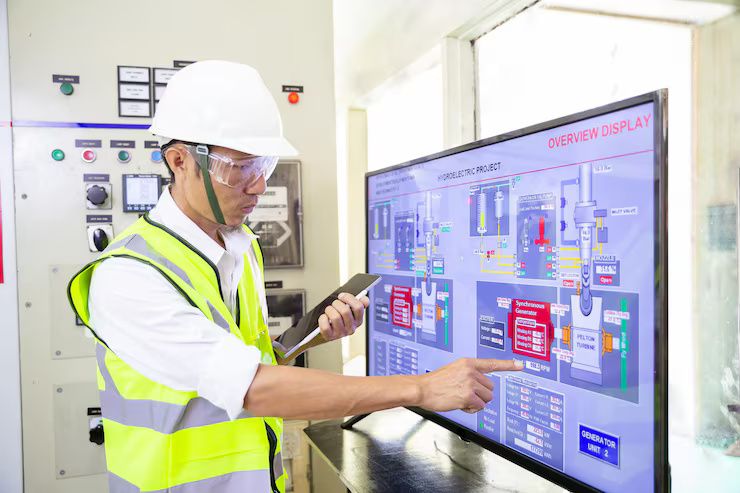
Understanding how industrial HMI touch panels function helps engineers, technicians, plant managers, and automation professionals recognize their role in improving operational visibility, equipment reliability, and production efficiency.
Human-Machine Interaction in Industrial Automation
Every automated production system requires an effective way for people to communicate with machines. Industrial HMI touch panels serve as that communication layer by converting complex machine data into graphical displays that operators can easily understand.
Instead of interpreting numerous control signals separately, operators can monitor alarms, production status, equipment performance, and process variables through a single interface. This centralized visualization simplifies routine operation while supporting faster decision-making during changing production conditions.
The HMI also allows users to issue commands, modify production parameters, acknowledge alarms, and review historical operating information without directly interacting with the underlying control hardware.
Core Functions of Industrial HMI Touch Panels
Although designs vary across industries, most industrial HMI touch panels perform several essential functions that support daily production activities.
These functions commonly include:
- Machine monitoring
- Process visualization
- Alarm management
- Equipment control
- Recipe selection
- Production reporting
- System diagnostics
- User authentication
- Historical data review
Together, these capabilities provide operators with both operational control and continuous insight into machine performance.
Integration with Industrial Control Systems
Industrial HMI touch panels rarely operate as standalone devices. Instead, they communicate continuously with automation equipment throughout the production system.
The most common connection is with programmable logic controllers, which execute machine control logic. The HMI exchanges information with the controller by displaying sensor values, equipment status, production counts, and alarm conditions while transmitting operator commands back to the control system.
Many installations also connect HMIs with variable frequency drives, servo systems, industrial sensors, barcode readers, robotic equipment, and supervisory monitoring software. This level of integration creates a unified operating environment where multiple devices exchange information in real time.
Hardware Features Designed for Industrial Environments
Unlike consumer touchscreen devices, industrial HMI panels are engineered for demanding operating conditions.
Manufacturers design these interfaces to withstand vibration, dust, humidity, electrical noise, and temperature fluctuations commonly found in production facilities. Rugged enclosures help protect internal electronics while maintaining reliable operation over extended production cycles.
Common hardware features include high-brightness displays, capacitive or resistive touch technology, industrial communication ports, solid-state storage, fanless cooling systems, and durable front panels that resist moisture and contaminants.
These design characteristics support dependable operation in environments where equipment reliability is critical.
Software Enhances Operational Visibility
Modern HMI software has become significantly more advanced than early graphical interfaces.
Operators can view animated process diagrams, equipment status indicators, production dashboards, maintenance notifications, and alarm histories through customizable display screens. Color coding and graphical symbols improve information recognition, allowing personnel to identify abnormal conditions more quickly.
Many HMI platforms also support multiple user access levels, ensuring that maintenance personnel, operators, supervisors, and engineers receive appropriate system permissions according to their responsibilities.
Remote visualization capabilities further extend operational flexibility by allowing authorized users to monitor production systems from secure network locations.
Communication Technologies
Industrial HMI touch panels communicate using standardized industrial networking technologies that allow interoperability between automation devices.
Common communication methods include Ethernet-based industrial networks, serial communication protocols, fieldbus systems, and manufacturer-specific communication interfaces. These technologies enable HMIs to exchange information with controllers, sensors, drives, remote input/output modules, and enterprise production systems.
Selecting compatible communication protocols simplifies system integration while supporting future equipment expansion.
Factors That Influence HMI Selection
Choosing an appropriate HMI involves evaluating operational requirements rather than focusing solely on display size.
Several technical considerations influence selection:
| Selection Factor | Importance |
|---|---|
| Display size | Determines visibility and information capacity |
| Processing capability | Supports responsive graphical performance |
| Communication compatibility | Enables integration with automation equipment |
| Environmental protection | Ensures reliable operation in industrial conditions |
| Screen resolution | Improves readability and interface clarity |
| Expansion capability | Supports future production requirements |
| Software compatibility | Simplifies engineering and maintenance |
Evaluating these factors helps organizations implement interfaces that remain effective throughout the equipment lifecycle.
Benefits Across Manufacturing Operations
Industrial HMI touch panels contribute to production efficiency by improving information accessibility and simplifying equipment operation.
Operators can identify process deviations earlier, respond more quickly to alarms, and monitor equipment from centralized interfaces rather than relying on scattered control devices.
Maintenance personnel benefit from built-in diagnostic information that helps locate equipment issues more efficiently. Production supervisors gain greater visibility into machine utilization, downtime events, and operational performance through graphical dashboards and reporting functions.
These improvements support better communication between production teams while reducing unnecessary operational complexity.
Emerging Developments in HMI Technology
Industrial HMI technology continues evolving alongside broader digital manufacturing initiatives.
Modern interfaces increasingly incorporate web-based visualization, remote access capabilities, edge computing, cloud connectivity, and advanced cybersecurity features. Some platforms also integrate predictive maintenance information generated through equipment condition monitoring and industrial analytics.
Improved graphics processors and higher-resolution displays further enhance operator interaction while supporting increasingly sophisticated automation systems.
As production environments become more connected, HMI platforms are expected to play an even greater role in presenting operational information gathered from multiple industrial systems within a unified interface.
Conclusion
Industrial HMI touch panels have become an essential element of modern automation by providing efficient interaction between operators and increasingly sophisticated production systems. Their ability to combine machine control, process visualization, diagnostics, and real-time monitoring within a single interface supports safer, more productive industrial operations.
As manufacturing technologies continue advancing, HMI systems will remain central to improving operational awareness, simplifying equipment management, and enabling more intelligent production environments across a wide range of industries.